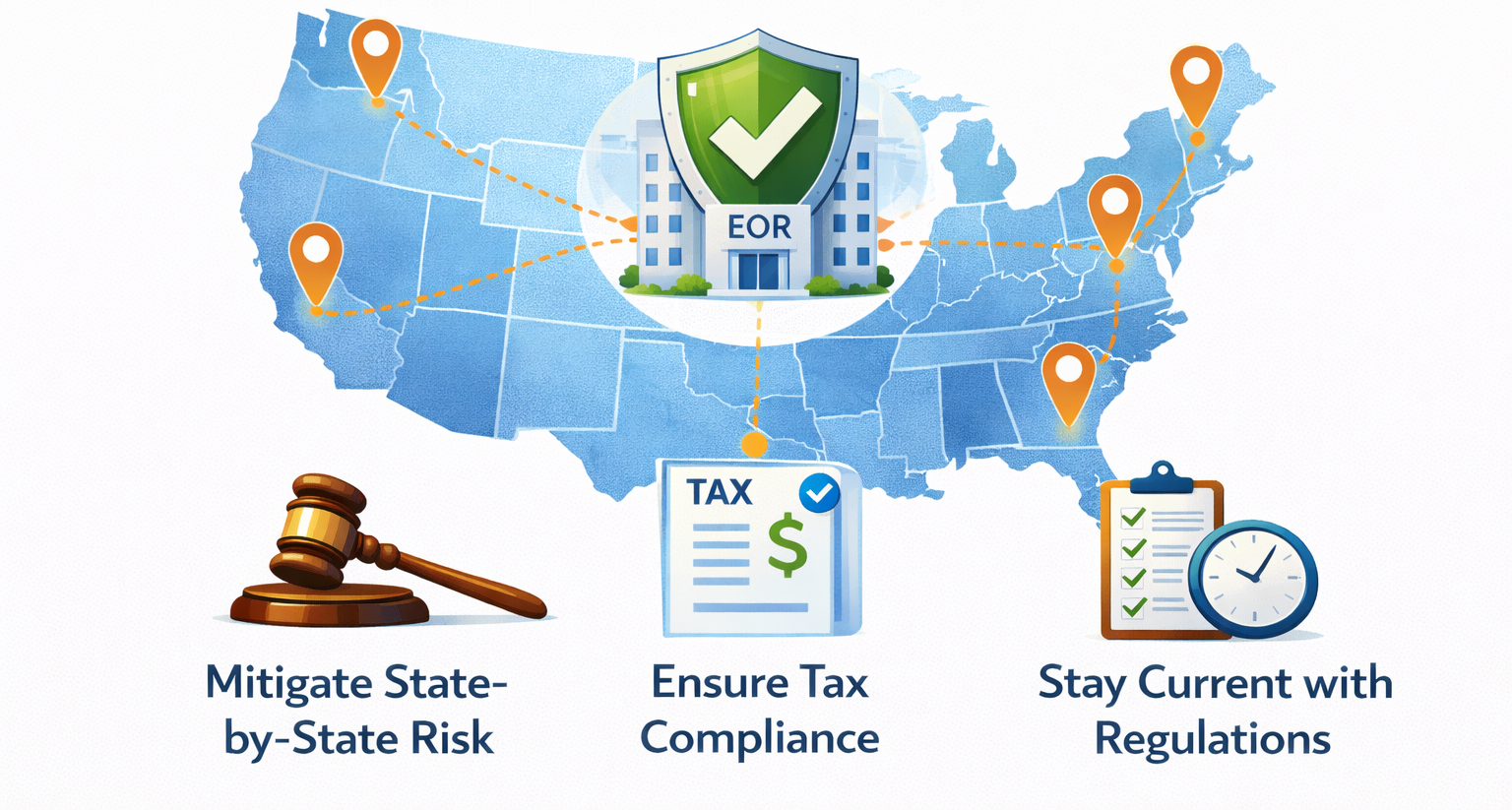
Every fast-growing company eventually hits the same wall: compliance slows hiring more than recruiting can speed it up. As teams expand across the U.S., employment regulations multiply – often faster than internal HR teams can reasonably track. That’s why smart businesses are turning to an Employer of Record (EOR) to take the compliance burden off their plate.
Employment compliance in the U.S. is far more complex than it is in Europe and many other regions. Shifting federal rules, strict wage laws, benefit mandates, leave, and reporting requirements – it’s a lot to decipher. The margin for error is small, and the consequences are real.
In fact, 34% of organizations faced at least one employment-related enforcement action in the past year, according to HR.com’s State of Legal Compliance and Employment Law 2025 report. In many cases, these are tiny errors caused by the sheer volume of rules HR teams are expected to manage.
50 States, 50 Rulebooks. One EOR Handles Them All.
Even at the national level, compliance is a heavy administrative burden. HR teams manage a lengthy list of compliance obligations, and the challenge compounds quickly when companies try to scale across multiple states.
Every state adds its own layer of rules around details like:
- Wage timelines
- PTO rules and payout procedures
- Workers’ comp classifications
- Unemployment insurance registration
- Pay transparency laws
- Onboarding and offboarding deadlines
- Prevailing wage rules (sometimes down to the zip code)
Tracking all this is a tremendous time suck. HR.com reports that one-third of HR teams spend 11% to 25% of their workweek on compliance alone – time that could be going toward workforce growth.
This is where an EOR changes the equation. Instead of building and maintaining compliance processes for every state, companies can bypass this step and hire anywhere fast using the EOR’s existing legal and operational infrastructure.
Multi-state compliance isn’t a problem to solve – it’s a problem to offload.
Why PEOs Don’t Remove the Real Compliance Burden (or Cost)
There’s a common misconception that Professional Employer Organizations (PEOs) “handle compliance.” In reality, PEOs operate under co-employment, which means companies still carry a large share of employer obligations and regulatory exposure.
With a PEO, companies must still:
- Register their business in each hiring state
- Open and manage state unemployment insurance accounts
- Handle many onboarding and offboarding requirements
- Maintain compliance with industry- and location-specific rules
As the company retains part of the employer role, PEO cost structure reflects that shared burden. PEOs typically charge higher administrative fees and require companies to pay for access to their benefits plans – in addition to the costs of maintaining state registrations and internal compliance oversight.
EORs, by contrast, already have the registrations, insurance, benefits, and infrastructure in place, making them a faster, cleaner, and more cost-effective option for hiring in the U.S. An EOR operates differently because the EOR is the legal employer.
Myth: “PEOs take on the risk.”
Reality: You still do much of the compliance work, remain liable, and pay more for it.
The EOR Advantage: No Registrations. No Waiting. No Risk on You.
An Employer of Record takes on the entire legal and administrative burden of employing your workforce. Instead of sharing responsibilities like a PEO, an EOR becomes the full legal employer of record, absorbing the full compliance load.
With an EOR, companies don’t need to:
- Register in new states
- Open UI or tax accounts
- Manage workers’ comp coding
- Track wage timelines and final-pay laws
- Navigate state-specific PTO and payout requirements
- Monitor state-specific onboarding and paperwork deadlines
Headcount manages all payroll, tax filings, workers’ comp, benefits administration, wage compliance, and state-level requirements. Your team simply selects the talent and approves time. We handle the rest.
“With an EOR, hiring in a new state takes days, not months.”
Real-World Compliance Hiccups and Their Consequences
Compliance mistakes rarely look dramatic at first. One example: a company failed to update a new unemployment insurance rate after receiving its annual notice. The error went unnoticed until a state audit the following year, resulting in $200,000 in back payments and penalties.
Another common issue: missing final-pay deadlines in states like California, where payouts may be required within 24 hours of termination. Each day of delay increases statutory penalties.
These aren’t uncommon violations. They’re routine administrative details that carry real financial and legal consequences.
Ready to Scale Faster? Let Headcount Management Remove the Compliance Hassle
When companies scale across the U.S., compliance should not be the bottleneck. Headcount’s Employer of Record services eliminate registration delays, legal setup, and ongoing regulatory exposure, so growth can move at the pace of the business.
If you’re ready to hire anywhere in the U.S. without touching compliance, Headcount makes it simple. Serving as your Employer of Record (EOR), Headcount handles all the details of onboarding, payroll, compliance, employment administration, and legal requirements across all 50 states and Canadian provinces on your behalf so you can grow without the hassle or risk. Let’s talk about your U.S. expansion plans. Contact us today.